Research Project
Twisted String Actuation
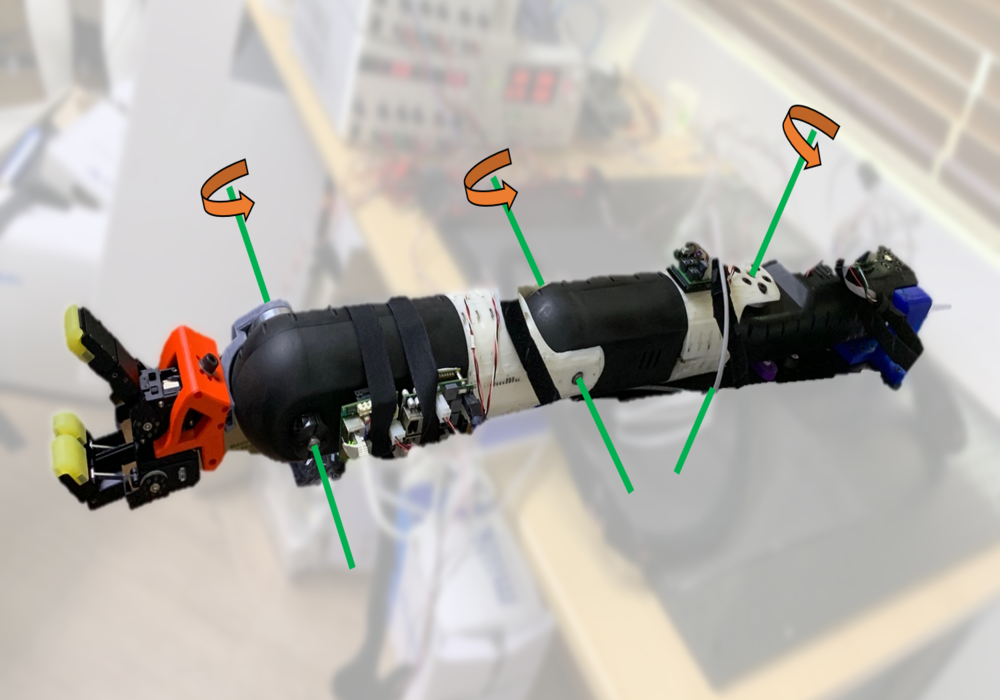
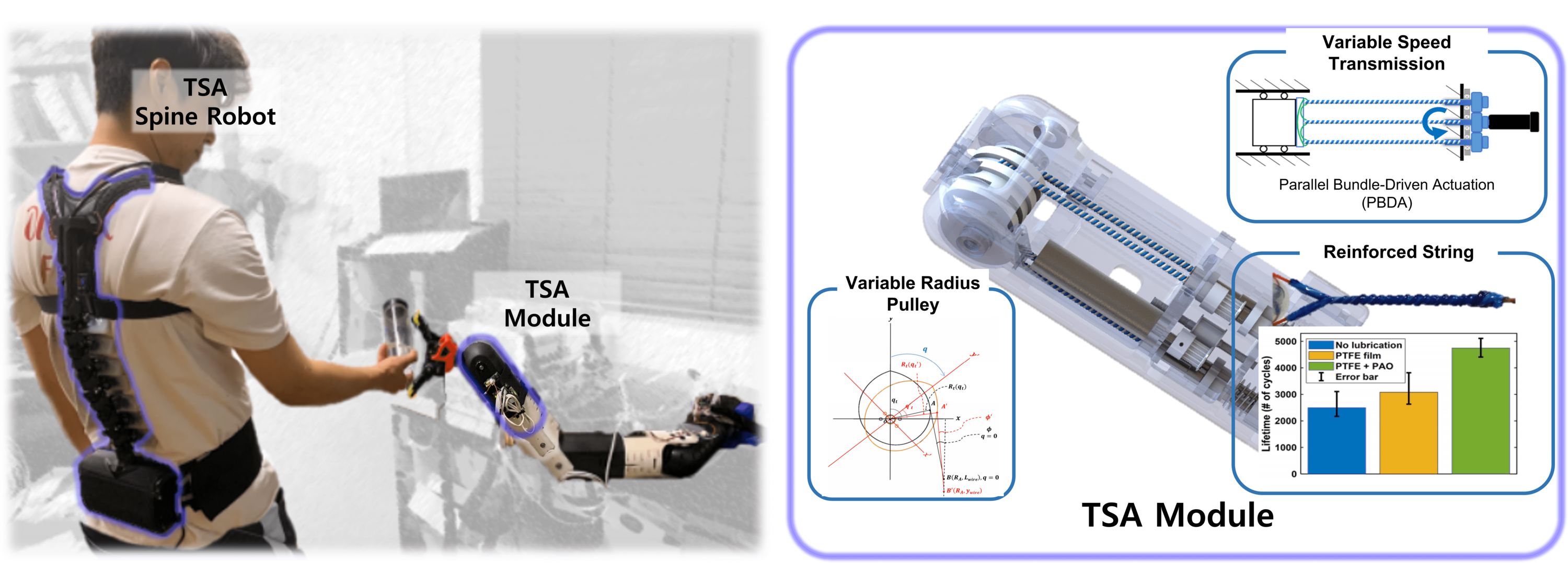
Overview of the TSA Robot Arm with TSA Spine Robot (left), Detailed Schematic of Single TSA Module (right)
For the development of human-friendly robots that are capable of collaborating with humans, it is essential to employ suitable actuators, which must be inherently safe, compact, light, and cost-effective at the same time. Owing to its actuation characteristics, twisted string actuators (TSAs) have been implemented as a promising solution for various human-robot interactive applications. However, due to its nonlinear actuation characteristics, lengthy design constraint (force output is proportional to its length), poor durability, and creep property of the TSA strings due to its inherent compliance, there was a need for a novel solution. To address these problems, we have developed new approaches in 1) mechanism design, 2) control, and 3) string fabrication: 1) variable radius pulley, parallel-bundle driven actuation, and creep compensator, 2) adaptive force control based on hybrid actuation framework, and 3) reinforced strings using specially treated lubrication technique with a replacement cartridge. Unlike conventional TSA robot joints, we were able to develop a modular robot joint that can be: 1) driven bidirectionally even with a single motor with a 47% reduction in length, 2) enhance the control bandwidth from 4.0 Hz to 6.0 Hz, and 3) significantly increase the lifecycle of the strings by over 100%.